Thursday, 8 October 2020

antique beads and bead styles shown

Carnival glass bead necklace 1960s

Antique beads and vintage bead styles shown here.

Beads have been around for centuries, our ancestors used seeds, bones and shells strung together to wear around their necks.
In today's blog, I have decided to look at some of the different styles of antique and  vintage bead necklaces available both costume and fine necklaces.
Above is an antique Carnival Glass necklace.

The most simple beaded necklace can be made by threading beads onto a string type of material to produce a necklace that is long enough to slip over your neck. Once the beads are l
ong enough the ends are tied together so no clasps are used.
These were popular in the 1920s with flapper revolution. Women wore their hair and skirts short for the first time and layered bead necklaces around their necks. 

Again in the 1960s, long beads came very much to the front of fashion for hippies. With their love beads, multicoloured clothing and jewellery to match - flower power very evident.

1960s vintage beaded necklace in green
1960s vintage beaded necklace in green. From Hong Kong and signed on the hook clasp. Three strands of beads in plastic.

Long green bead necklace in glass
A long vintage bead necklace from the 1960s. Shaped beads of glass in a lime green colour.
Multi coloured antique bead necklace
Bright stone beads dyed in bright colours. Antique and very unusual.

Long necklaces can be made from many materials, pearls, faux Red glass bead necklacepearls, Bakelite, celluloid, plastic, seeds, gemstones and wood to name but a few.
Today long necklaces can be wrapped around your neck once or twice to create a layered effect. Several different colours can be worn. Try a long black bead
necklace with a faux pearl bead necklace. It looks great with a plain t-shirt and an over shirt worn as a jacket.

Long necklaces can also double as bracelets. Wrap one several time around your wrist for that fashionable layered look.
Opposite is a long red bead necklace circa 1980s

A single string of beads with a clasp fitted is I think the next type of necklace for popularity. My pearl necklace is probably the one that I use the most for the day and going out in the evening. The clasps can be plain or ornate. Vintage necklaces with an ornate clasp were often better made and more expensive when new. Designed to wear with a hairstyle that left the back of your neck bare, so the clasp was clearly visible. Audrey Hepburn was a classic beauty with her black dress, long black gloves and a beaded necklace with an ornate clasp. Very stylish in the 1930s an
d 1940s when everyone went to the cinema and the Hollywood stars were copied
The clasp need not be at the back of the neck. Today such a necklace can be worn with the clasp around the front in any position. 
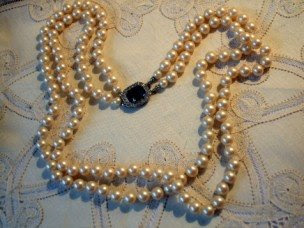
Double stranded bead necklace of glass pearlsDouble stranded bead necklace of glass pearls with a blue rhinestone clasp.

Multi-layered bead necklaces have been fashionable for centuries. Even in this issue of December's Vogue UK, there is a multi-layered bead necklace by Chanel. The clasp has been replaced by a bow, quite easy to copy at home - if the ££££ price tag is a bit too much. Just attach a bow available from haberdasheries to a long slip over bead necklace or to a plain clasp on a shorter layered necklace. Coordinate the bow to match the necklace.
Coral bead necklace 1960s
Coral bead necklace 1960s with an ornate clasp.
Milk glass beaded necklace 1960s
Milk glass beaded necklace 1960s with an ornate clasp fastening.
Antique Tigers Eye bead necklace
Antique Tigers Eye bead necklace - see the irregular shape of the beads that have been hand cut.
Yellow long bead necklace 1920s

Yellow long bead necklace 1920s with metal pin links.

Tuesday, 29 September 2020

Charles Horner jewellery of Halifax UK

Charles Horner jewellery | CH jewellery History.

Once of Halifax UK, this company produced a wide range of items from jewellery to buttons, ornaments, hat pins and thimbles. Famous mostly for the Art Deco silver jewellery it produced. However they also made a wide range of costume jewellery, ornaments, buttons, hat pins, thimbles and other metal and plastic items.

Charles Horner himself lived from 1837 to 1896. He started his jewellery business in 1860. Producing first silver jewellery. Later he became more well know for his Art Nouveau silver and gold hat pins, Art Nouveau pendant necklace as well as his twisted wire silver and paste knot brooches. In 1884, he patented the Dorcas thimbles. These thimbles were made to be more hard wearing than the softer and more pliable previous thimbles available. Thimbles were made up until 1947. His two sons and partner continued after his death. Eventually expanding the business into a very large company. 

One range was the Staybright shiny metal jewellery, with dimpled surfaces that glitter and were a poor man's “marcasite” reproduction style. The Staybrite jewellery is now very collectible today. 
Charles Horner Staybrite brooch - Art Deco design


There was also a wide range of cameo pieces produced in casein – a type of plastic. This range was called "Dorcasine" Very recognisable and also now very sought after.
Dorcasine cameo by Charles Horner

Dorcasine curly haired lady cameo by Charles Horner

Dorcasine Gainsborough lady cameo by Charles Horner

Books are available on the jewellery and ornament range for further information. However most Charles Horner costume is unsigned and can be difficult to identify. Mainly because over their long history. But many of the silver pieces are - with the stamp CH. 

Sadly the decline in sales brought about the companies demise in 1984, when it went into liquidation. 
We have just some of the Charles Horner jewellery and accessories found on my travels.
spider brooch in Staybrite by Charles Horner

Sailing ship brooch in Staybrite by Charles Horner

Seahorse brooch in Staybrite by Charles Horner

Olden day ship brooch in Staybrite by Charles Horner

red sailing ship brooch Staybrite by Charles Horner

Pelican brooch Staybrite by Charles Horner

Peacock brooch Staybrite by Charles Horner

Deer brooch Staybrite by Charles Horner

Brooches in Staybrite by Charles Horner

Bow brooch in Staybrite by Charles Horner

Back brooches in Staybrite by Charles Horner

Swallow brooch in Staybrite by Charles Horner

Art deco style charles horner brooch

Art deco style charles horner brooch back

back of swallow brooch charles horner

back of curled leaf brooch charles horner

curled leaf brooch charles horner

casein cameo brooch charles horner

casein cameo brooch charles horner back view

casein cameo brooch charles horner no frame

casein cameo brooch charles horner back view

woman in hat cameo brooch charles horner

woman in hat cameo brooch charles horner back
Updated September 2023

Saturday, 26 September 2020

What is the difference between rhinestone and diamante

What is the difference between rhinestone and diamante?

What is the difference between diamante, rhinestone and crystal? It seems today each term is used for the same type of simulated diamond style stones in jewellery. So lets look at each in turn.
Diamante – well those in the UK seem to use this term for sparkling stones in jewellery. Years ago it used to be only used for the sparkling sequin stones that were sewn onto garments to add sparkle. But somewhere between the 1950s and 1970s it became a household name for the stones used in jewellery. Today it is still used widely in the UK with various forms of spelling for example diamonte, dimonte and diamantes. Here on Jewels and Finery we use it for the less sparkling and quality jewellery we have, including acrylic diamante.
1980s diamante clip earrings
Unicorn diamante brooch modern
Rhinestone – this is the term used in the US for all sparkling stones in the past and even today. Large or small, pave, foiled backed or unbacked. The name originated from the Rhine in Germany, where rock crystal gemstones were found. In the eighteenth century, a manufacturer called Strass found a way to turn glass into shiny like stones called the totally original “Strass”.  Earlier in the seventeenth century glass with a high amount of lead, called paste was used first by the gentry. Afraid of getting robbed many people started to replace diamonds and other gems with paste. This lead to the fashion of paste and eventually the popular non precious stones or artificial gemstone use in jewellery. Paste reached its peak use in the late 18 century, because of Strass and his glass rhinestone invention.
D'Orlan heart brooch with pave rhinestone
Gold mesh and clear rhinestone necklace
Crystal – Swarovski and the jewellery makers of Bohemia and Austria are responsible for this term. Crystal is just high quality and super shining glass rhinestones or beads. It is also called Austrian crystal or Bohemian crystal. In 1955, when Swarovski produced a coating to clear rhinestone glass that gave it that “oil on water” effect that soon became very much prized in the world of jewellery. Today the term crystal is used loosely for Swarovski crystal rhinestone of a huge amount of colours and coating finishes, with clear glass beads or above the shaped crystal used in this rose brooch – Swarovski made is the best available.
Jewel Crest brooch with Swarovski crystal rhinestone

Blue glass pendant necklace by Exquisite
Swarovski glass pendant necklace by Exquisite has that wow sparkle that comes from Swarovski crystals.

Friday, 25 September 2020

Exquisite leaf jewellery

Exquisite loved leaf jewellery. 

In their long history, they produced so many different versions of their jewellery leaves in large and small leaf brooches and earrings. This jewellery blog has some original information leaflets. We are also photographing and showing all the leaf jewellery for your pleasure and ongoing research.
curled leaf brooch by Exquisite
The Exquisite company produced leaves in Vine, Beech, Horse Chestnut, Elm, Ivy, Cherry, Hazel, Pine, Mour ‘N Ash, Oak, Mulberry and also Sycamore. They used a variety of finishes from hand painted enamel, gold, silver in a plain tone or textured and many different designs.

The above is a cherry tree leaf brooch by Exquisite in an all textured gold tone. This design can be found in a variety of finished and colours making it ideal to collect. It is also in a large and small size and matching earring clips can be found still.
Holly enamelled clip earrings by Exquisite

Holly enamel clip earrings by Exquisite
Above are the vintage cherry leaf earrings – clip style to match the enamel cherry leaf brooches.
Sycamore jewellery or also know as a leaf from the helicopter tree. Throw the seeds in the air and watch them twirl down to the ground. This Sycamore leaf brooch is hand enamelled. So you will find different color tones and looks. Again in a large and small size with matching earrings to be found.
Silver cherry leaf brooch by Exquisite

Conker leaf brooch by Exquisite

Golden ivy leaf brooch by Exquisite

Enamel leaf necklace by Exquisite

Golden sycamore leaf brooch by Exquisite

Mountain ash enamel brooch by Exquisite

Gold leaf vintage necklace by Exquisite

Enamel sycamore brooch by Exquisite
Another version of the Sycamore from Exquisite in an all textured gold tone and a smaller size.
The large leaf is we think from an Elm tree sprig below with the colourful distinct seeds – but we have been wrong before.
Enamel Mulberry brooch by Exquisite
This is a Mulberry leaf although the fruit is like a blackberry - it is part of the Birthday range.
Cream enamel leaf brooch by Exquisite
 It is an unusual brooch in a cream enamel with raised gold textured edging.
The horse chestnut brooch or conker as more known. Beautifully enamelled by hand is the one in the above photographs. Again found in all sort of finishes.
Or jewellery blogs are ongoing and we add more as we have sourced and photographed it.
Other blogs on Exquisite jewellery:
Rose and flower jewellery by Exquisite.

About Me

My photo
Solihull, West Midlands, United Kingdom
I preserve the past. Researching family and local history. Finding about mine and other people's ancestors, is just one of my passions. I also love vintage costume jewellery made here in the UK. I write about my finds and like to research.